Seismic Evaluation of Pavement − Technical Development
Please visit MASW site for more detailed information about all references cited.
In the process of road construction, it is important to achieve a level of stiffness and thickness of road materials that can sustain expected load stress. In this sense, quality management can be regarded as being analogous to in-situ stiffness and thickness (H) measurement of road beds. Previous research has established seismic shear-wave velocity (Vs) as one of the most direct indicators of a material's stiffness (Sheriff, 2002). The multichannel analysis of surface waves (MASW) method (Park et al., 1999) has been widely used to measure shear-wave velocity (Vs) and layering information of the near-surface materials (e.g., < 30 m).
Park and Richter (2017) used the conventional MASW approach with geophones on quadruple land streamers to evaluate seismic velocities (Vs's) of road structure during a Full Depth Reclamation (FDR) construction of an HMA road. The evaluation of the top pavement (HMA), however, was beyond the ability at the time because of the microscopic depth range that would require measurements of very-high-frequency (VHF) surface waves (e.g., 30 kHz), which is far beyond what the conventional geophones can record (e.g., 1 Hz − 300 Hz). Ryden et al. (2004) first used the MASW approach to measure velocity and thickness of asphalt and concrete pavement by using accelerometer as receiver.
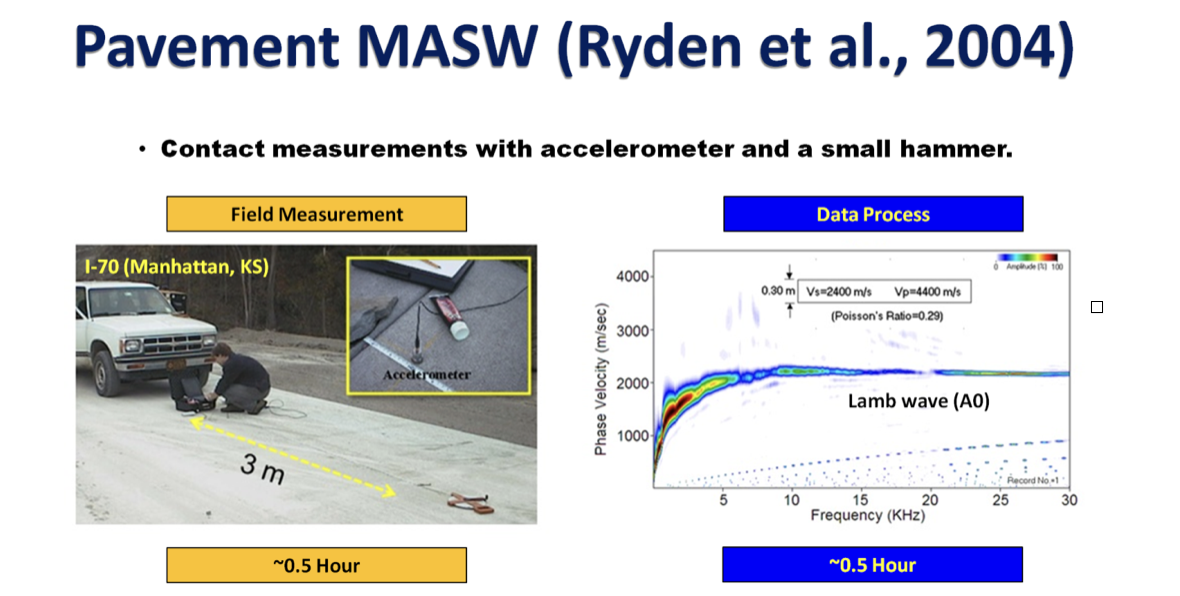
Early-Stage Contact Measurement (Ryden et al., 2004)
Although Ryden et al. (2004) first applied the multichannel seismic approach to record the pavement surface waves in 1-30 kHz by using an accelerometer, it was impractical because of the slow measurement speed (e.g., one hour to complete an one-point measurement).
Non-Contact Measurement with Microphone (Ryden et al., 2006; Bjurström and Ryden, 2017)
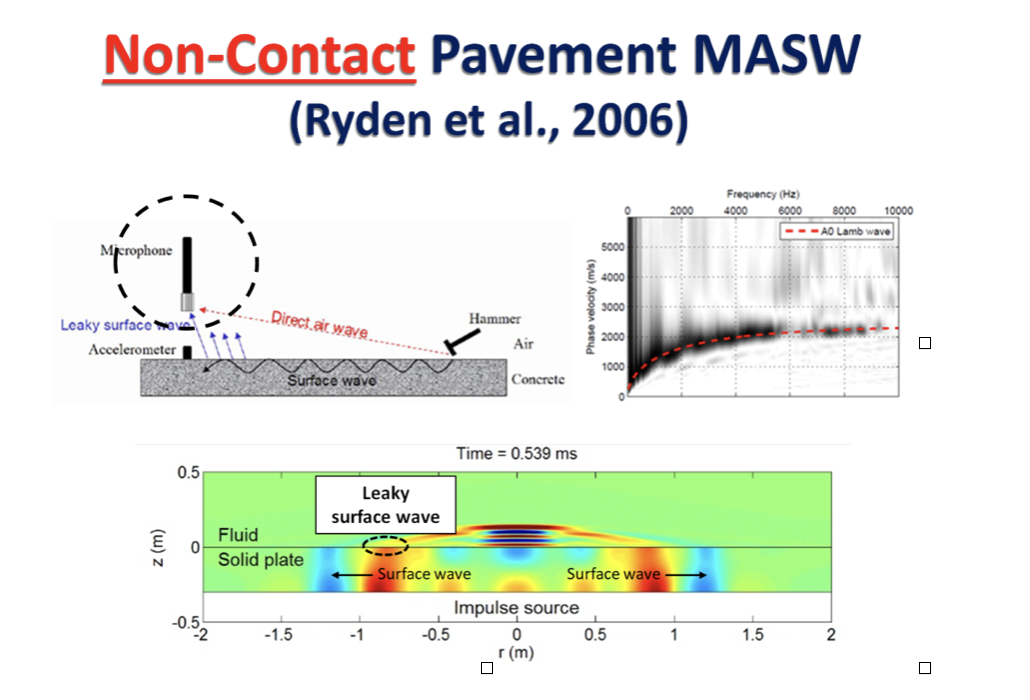
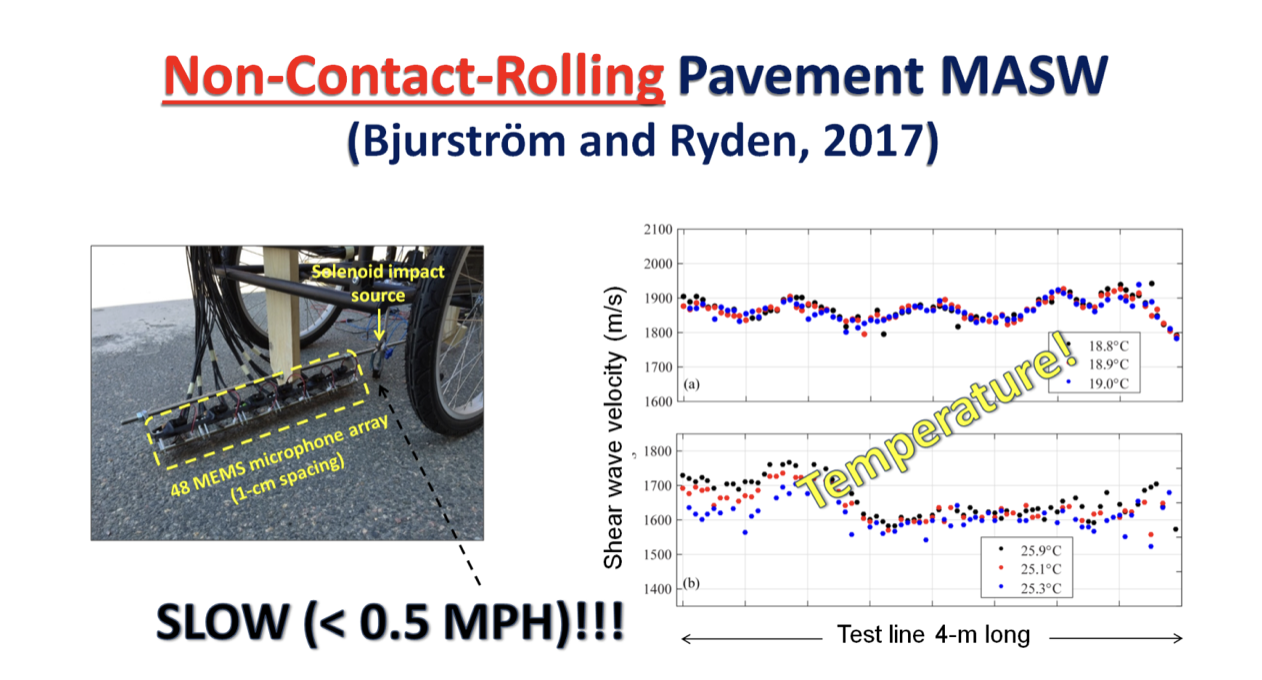
Ryden et al. (2006) combined the microphone approach to record leaky-mode surface (Lamb) waves (Zhu and Popovics, 2001) and MASW approach. It showed the multichannel wavefield transformation method can delineate detailed properties of plane-wave propagation of pavement surface (Lamb) waves, while it also showed the microphone approach can provide an extremely convenient and fast data acquisition mode. Bjurström and Ryden (2017) first showed the feasibility of rolling measurement by using a solenoid impact source, which, however, prevented the acquisition system from moving fast and, therefore, was the main obstacle to make the approach practical.
Rolling Measurement (Ryden et al., 2019)
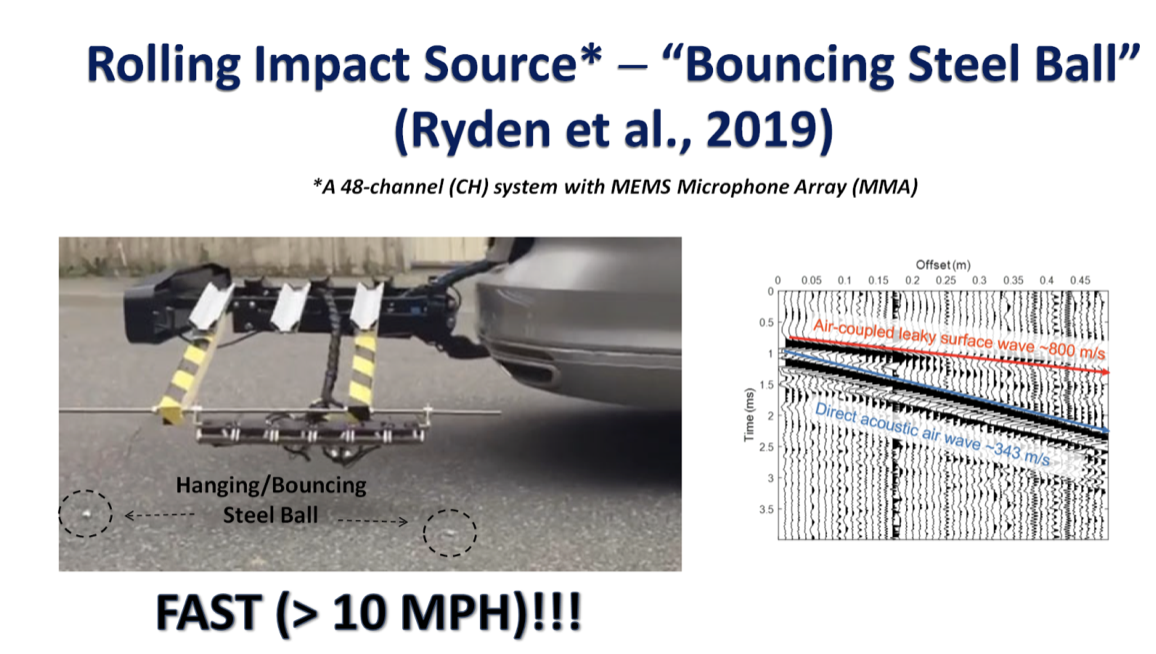
The most recent development of non-contact rolling measurement by using micro-electro-mechanical sensor (MEMS) microphones and spontaneously bouncing impact ball opened up a completely practical approach that can continuously survey at a speed of 10-30 MPH while recording the leaky-mode surface waves radiated from the pavement surface (Ryden et al., 2019).
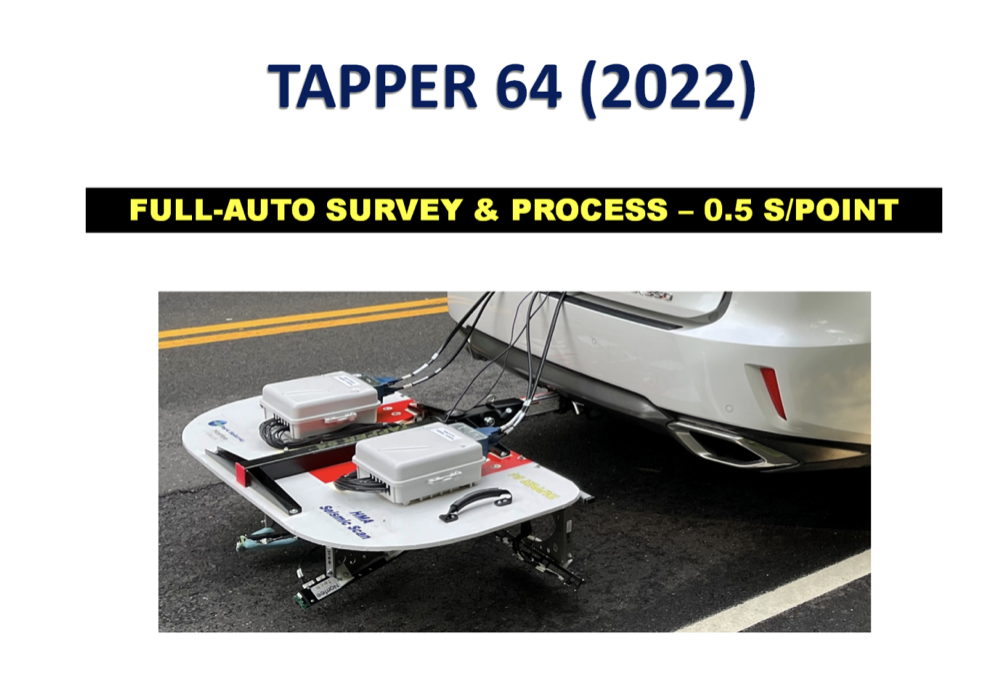
TAPPER 64 consists of four (4) 16-channel receiver arrays that are transversely arranged to survey a certain width of the pavement (e.g., 0.5-m) simultaneously. Each array has 16 micro-electro mechanical sensor (MEMS) microphones linearly arranged with a 2.25-cm separation. The arrays record seismic surface waves generated when a small cap bolt taps on the pavement surface. The acquisition-control and data-process software package, called ParkSEIS (PS)-HMA, that is installed in an onboard laptop computer analyzes acquired seismic data in a fully automated way and displays output results in a pseudo-real-time mode as survey vehicle travels. Detailed technical and operational contents in hardware and software components of TAPPER 64 are presented in the TAPPER 64-User's Manual.